Showing posts with label Mark. Show all posts

Monday, July 16, 2018

Forage Fri- uh, Sunday?

This past Sunday 7/15 I went to a foraging class hosted by The Larder in Ohio City.  We went to a park in Portage County for a 2-hour walk around.  I declared my hopes beforehand to my wife, to learn 3 new plants while I was there.  I was worried on the ride in that I would be overwhelmed with new information.

As the class started we went to the edge of the parking lot where a staghorn sumac tree was.  Having already recognized it as we were walking over I started to look at the skirt of the lot and see what else was growing there.  I spotted 7 wild edibles, our guide Jeremy talked about 5 of them (the out-of season cattails and rose hips not coming into the discussion.)  I was glad when we got into the woods across the street to explore new worlds.  To seek out new life, and you get the point.

Did I learn 3 new plants? Yes and no.  My friend Sarah had asked if I'd ever seen an American Spicebush. I had not, though I asked Jeremy if he could keep an eye out for one.  He did eventually spot one and I was able to crush a leaf to get the scent in my brain.  I learned characteristics of a few mushrooms, and a few new uses for items I have already been collecting.

I did see a few new mushrooms but though edible I don't know that they would be a food of sufficient quantity to be worth foraging.  There were some small puffballs that I became acquainted with and learned a bit more about the family, but they were so small as to barely create a garnish.  We saw some boletes and learned about the ones that probably wouldn't cause you too many GI issues but specific species and personal chemistry may make them less than desirable.

Jeremy did spot a tree from the top of the cliffs with white stuff at the bottom he was guessing were oyster mushrooms, which were in significant enough quantity to be worth collecting.  This was a great scout on his part. A lot of times when foraging you just look for what is very near to you and don't look up to spot the bigger finds.


I and another forager on the tour collected our share from the tree, avoiding the yellow slime.  Our small parlay revealed that he was originally from NJ and that his mother, who had gone missing a bit earler, had gone to the car.

As a note you should avoid any such mushrooms growing on a dead conifer, these are likely angel wings and have been linked to several deaths in Japan (suspected to be related to radiation, so the legend goes.)  We had a good conversation about look-alikes so I feel this is a solid addition to my repoire, and he was good enough to give his phone number out so the attendants can text pictures for verification.

We also saw a mushroom whose layman's name is 'milky cap', whose coloring on the top reminded me of a peach and whose underside bled latex when cut;


These were large-ish and I imagine if you found a locale dominated by them they would be worth collecting.  The lucky spotter of these got 3 good-sized mushrooms.

Jeremy was an excellent guide.  He is certified in mushrooming (I don't know the technical term, but he's certified) and knows way a lot about wild plants.  He knew the scientific name (at least to the family) of just about any scrap of mushroom anyone held up in front of him.  I think the locale could have been better, something not dominated by giant rocks. I understand it was probably a good chantrelle location but the lack of rain   I think some flat terriain with an assortment of biomes might have helped.  The class was a little mushroom-dominant based on the area we were in, which was an older forest with little undergrowth aside from a decadent amount of poison ivy and dominated by rock walls.  Had it been rainy this week I'm sure I would have been showing off a sack of chantrelles like I did from my forage last week.

At any rate, I didn't get home until late on Sunday and after several chores finally had the opportunity to address the sack of oyster mushrooms I brought home.


You can see the miniscule puffballs in the lower right and a pot in my sink in the upper left.  I decided to blanch them to kill all the...everything crawling around inside and keep them from further deteriorating.  Today (Monday) I fried a few in the skillet along with red peeper, garlic, onions, and mugwort.


My phone has recently suffered irreperable damage so the right side of my picture is black.  Also, my framing is terrible.  I should use a real camera, but too bad.  
I feel like the gilled sections of this mushroom could soak up a lot of flavor from some sauce, and the stems should probably be cur off and chopped and used elsewhere. 

In summary, this was a great novice class.  Though I gleaned limited knowledge from it I did learn some new food sources.  I would encourage any wallflowers who are in the Cleveland area and interested in foraging to sign up for one of their classes. I could see that there were a few fellow attendees who, for lack of a better analogy, weren't at their first rodeo.  I'd be interested to see if they would offer an advanced level class.


Forage Friday IV (which actually took place on a Friday, but still took me 4 days to write about)


Here is the catnip I promised to photograph.  It has flowered as you can see.  For identification the stalks are square and it smells of mint, but when you taste it its not really great mint.  Still, its edible.


I found a small number of ripe blackberries out in an open field, but on a periphery I found these still young ones in quantity.  I expect to find some mature fruits this Friday.


The chantrelles were in abundance a week ago, but these poor little dried specimens were all I discovered this week.  Rain has been absent for probably 8-9 days.  It did rain a bit today (the following Monday) so I am interested to see if more have come up.


Some local mayapples have some large green fruits (which are at this stage poisonous.)  I will keep an eye on them and see when they turn yellow if they are worth bothering with.


Wild Carrot, alias Queen Anne's Lace, are starting to flower.  This is a biannual plant so when you see the flowers the root underneath is a stick.  If you can find smaller greens nearby at ground level those are first year plants and the root isn't hardened.  The greens look like the tops of carrots you'd get in the store.  Always smell them, your nose knows.


Here is what I brought home to cook, a small haul in comparison to what I usually drag out of the woods but I was trying not to make a giant mess this week so I kept it polite.

Left to right, catnip, a carrot root, staghorn sumac, garlic bulbs, another carrot root, garlic bulblets, burdock root. 

The mulberry tree had a few pink berries but only like 3 ripe berries.  I didn't feel like walking all the way to the previously mentioned apple tree (which is about a mile away) so my meal was light on a fruit/desert dish this week.


I found a hot pepper I had dried a few years ago and along with some garlic, black walnuts, and chantrelles made a sauce for half a rabbit I pulled from the freezer.  The walnuts/garlic/pepper were AWESOME when I tasted them, the chantrelles didn't really compliment the taste very well but that's what I added so that's what I ate/  At the bottom of the picture are the burdock roots I collected, boiled to hell for about 40 minutes. At the top (like 1:00) there are the bulblets from the garlic plants, boiled along with the burdock roots. At the right was an attempt to rehash a previous idea - after forage friday II I took the leftover roast garlic/basswood nuts and mixed it together and made a few patties that didn't hold together well, pictured below, but were nonetheless good.  I attempted to retry this but without the basswood nuts, what I had crumbled to bits (BUT WAS DELICIOUS.)  In the background is tea I made with the sumac cones I had picked.


Those are the previously mentioned patties, they were crumbly but good enough to flip and get on a bun. 

As for this week's ratings, I'd give the rabbit with walnuts, mushrooms, and pepper a 6.5/10.  I'd lose the chantrelles and probably hammer out the rest of the rabbit, the filets from the back were the only really great meat part.  The garlic bulblets 6/10, its a nice vegetable once it spends half an hour boiling away.  Burdock I'd give 5/10, its a little plain jane but its nice to have a starchy vegetable even if it is a lot of work.  The failed rabbit/garlic patties get an 8.5/10, it was delicious if not what I envisioned it should be.  Sumac tea 6/10, good but the cones aren't quite ready. In a couple weeks this tea will be exquisite.

Friday Forage III (which happened on a Thursday, and I didn't bother to write about for 11 days)


Chantrelles.  In great quantity.


My friend Matt and I went out to our 'spot' for Chantrelles on Thursday, July 5th.  There were rains the few days before, and the forest floor was virtually blanketed in orange.  In the lower right are a few black trumpets and a couple old men we spotted, but the big haul were the chantrelles.  My bag (the white one in the foreground) weighed in a 4-1/2lbs at the end of the day. 


I did not make my typical 'only from the woods' meal this week, instead I made linguini with chantrelles in white sauce.  2 weeks ago I could have told you the ingredients but by now I have forgotten.  There was definitely cheese.  It was very good, a 9/10 on the foraging scale and at least a 6/10 on the fine dining scale.

Chantrelles are a ground mushroom and thus are always a little gritty, the only real detractor from the experience.  I think if you just focused on the 'caps' you'd probably be pretty grit free. 

There was, of course, some loss when I cleaned them and weeded out all the questionable and really filthy ones. I think I ate a pound.  The rest were divided into different preservation methods - 2/3lbs dried, 1/2lb sauteed and then frozen, 1/2lb blanched for 2 mins and frozen, 1lb left in a crock pot over night then frozen.  I have yet to revive these stores but will report which method was the best when I do.

Friday, June 29, 2018

Forage Friday Part II

I went out again this morning before it got too hot.  I saw pretty much the same as last week, I won't reshoot everything I already did, with a few additions.  The mulberry tree still has pink fruits on it so I should be able to collect again next week.  Garlic is ever-present.  The wild onions are nearing the end, there were a lot of dried stalks with aerial bulblets on them and only a few green stemmed ones left.  Here's what I found new (or just happened to notice this week)

Wood Sorrel - it looks a bit like a clover, it has a distinctive lemon taste.  Don't make this a primary food source as it contains oxalic acid, which is bad for you in large quantities.


Chicory - if you've ever played Skyrim, you know this as blue mountain flower.  Its roots are used to make a coffee substitute.  I collected a bit but it needs to dry.


Chantrelles - I found my first one of the year!  These small orange/yellow mushrooms can be found on the forest floor.  As always with mushrooms, if you're not sure throw it out!  I'm sure on this one though, and I've found a spot near me where they are growing (so I don't have to drive 40 minutes to my other spot.)


Basswood nuts - I just missed the window on what I think is a new and good source of wild food.  I had previously found these nuts to be edible when they drop on the ground though they are tiny and have 2 shells.  The first can be peeled and the second one you can crack by heating them in a pan, they reminded me of popcorn kernels I recall.  I was by our old house on Sunday and for no good reason picked one of the unripe flour/seeds.  It was nutty and a little sweet.  Today the flowers are falling off and the nuts are much greener.  I still picked a small container of them, even though I think they are past their prime.  I will have to try to get them a little earlier next year.


Sir Not Appearing in this film - there is an apple tree between our old house and current residence that always drops fruit on the sidewalk, and always seems to be fruiting too early.  I stopped there on the way and sure enough, I collected a pocket full of small under-ripe apples!


Here were my collections for the day, clockwise starting at noon - mugwort, garlic, burdock root, mulberries, wild onion bulblets, basswood nuts, wood sorrel, apples.  Off to the right is a sumac cone soaking in water.  


So here is what I managed to craft.

Back row, soup made from the mushroom broth mentioned in my last post, this was a little too strong and a bit bitter.  I added water later but haven't revisited it since I was full.  Sumac tea, the cone was still a little weak, it should have a good strong vitamin C flavor.  It really reminds me of Dairymen's tea when its good.  This was passable.  Basswood tea, this was a byproduct of boiling the hell out of the nuts, it had a fairly good flavor.  I dropped a bit of catnip in there, which is a mint relative that grows around here.  I guess I'll photograph that next week.  Anyways that and a bunch of sugar and I had a fine beverage.

Plate, clockwise from noon; apples and mulberries, uh, compote? I don't really know what a compote is but I guess that's what I'll call this.  I feel like this took a lot of sugar to sweeten up since the apples were so dry and tart, but the final outcome tasted good.  Rabbit, uh, pate?  I was trying for a pate but there isn't enough fat so its really just shredded meat.  It tastes good, its made of meat after all.  Apple and Maple glazed rabbit, this was the best of the plate.  I took the other (front) half of the rabbit I started on last week, and cut 2 good strips of meat off the back.  I am saving the legs for a bbq tonight.  The rest I threw in a pot with the burdock root and boiled into the previously mentioned 'pate'.  Back to the fillets, I put the apples in enough water to cover them and cooked them down until they were soft, I added the fruit into the mulberries that were already cooking and saved the liquid.  To this liquid I added some sugar and let it reduce down a bit.  I pounded the 2 fillets thin with a kitchen hammer, then dipped them in the maple apple glaze and then cooked them in a cast iron skillet.  These were completely devoured.  Burdock root, after last weeks experience I figured out how to deal with these roots.  If you have ever peeled the center out of a carrot, that is pretty much what you have to do to these roots and then boil them for an hour.  They were acceptable, a bit like a starchy asparagus.  Roasted garlic, I just put some of the bigger cloves in the cast iron pan and put it on a very low heat and kept rotating them until they were soft.  I have had better in restaurants but I haven't had much success prior to this on my own, so I call it a win!  Finally, mashed garlic and basswood nuts.  I boiled the hell out of both of these.  There wasn't that much mashed garlic so I added into the basically flavorless basswood nuts, resulting in something that feels very filling but a bit of a chore to eat.


Everything was at least edible.  Here's my ratings;  soup 3/10, weak sumac tea 5/10, basswood tea 6/10, compote 7/10, pate 7/10, glazed rabbit 9/10, burdock 5/10, roast garlic 6/10, mashed gruel 4/10.

Friday, June 22, 2018

Forage Fridays!

So I think everyone who opted in to this new challenge have either forgotten or are willfully ignoring its existence.  I have some stores of food I have collected and want to use them up, so I came up with the idea of Forage Fridays!  I thought it would be an interesting endeavor to see what is available in the wild each week and then try to make a meal from it.  I will for the most part use only what I have foraged, with the exception of salt (I do not feel like driving 9 hours to get to the ocean, I am sure one of our upcoming trips will get me much closer and I'll harvest some then.)

You should, of course, consult with a professional if you are looking to forage in your own area and not take any of my accounts or descriptions as canon.

What I found;

1) Mulberries.  A friend mentioned these were fruiting a few days ago, and it was my first stop on my tour of the woods.

2) Clover Flours.  In all varieties these edible flowers taste like green beans.  Go ahead try one, you'll be surprised!


3) Wild Garlic & Onions.  Your nose knows when you've got the right plant or a look-alike.  Always smell them as sometimes poisonous doppelgangers will grow nearby!  Garlic grows all around our place, I spotted some wild onion while walking in the woods.


4) Common Burdock.  We used to call these 'elephant ears' when we were kids.  I was pretty sure they were also known as 'Stadul weed' because I had only ever seen them in our yard while we were growing up. 

5) Wild Strawberries.  I had wandered through the woods nearby in hopes of finding some chantrelle mushrooms (which I hope grow in the woods near me.)  I found none, but did spot a few patches of wild strawberries.  They were scattered and I only got a handful but if necessity dictated I am sure I could gather more.


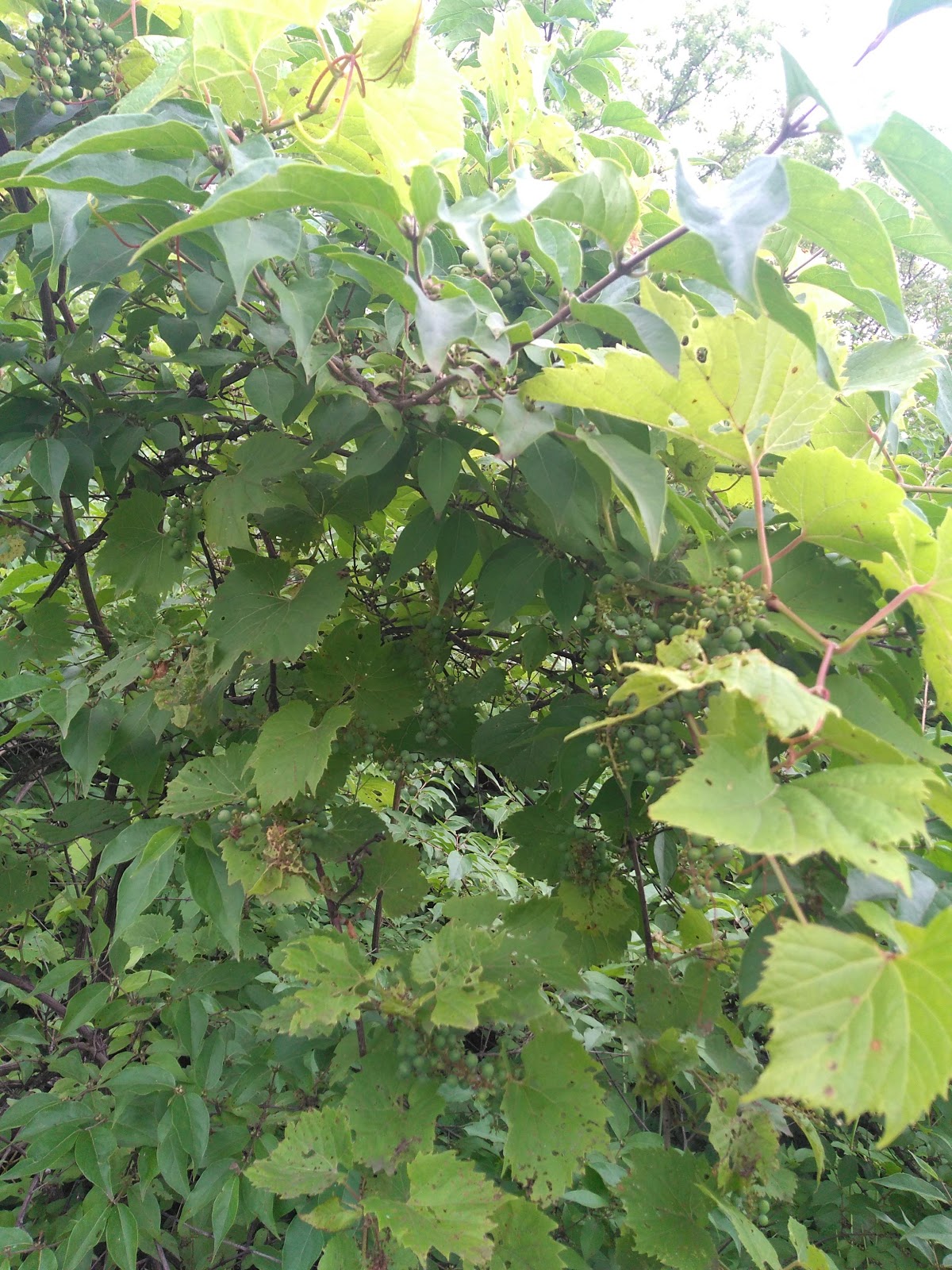
What's coming soon: I saw a few wild grape vines with green fruit on them, hopefully it will ripen in the next week or two.


 The sumac horns aren't quite red enough to harvest for drinks yet, hopefully next week they will.  I also spotted a blackberry bush, it looked a few weeks away from being ready.


The Meal:

For the past few memorial day parties I have been making a Slovak dish called 'Rabbit with Mushrooms.'  I thought I would try to recreate it with whatever I found.  The biggest problem being I don't have any good stores of fat.  Small game animals tend to be lean.  

To sum up, I took the back half of a rabbit (I don't want to use a whole rabbit on one meal, especially since I'm eating it alone.  Hopefully I'll have friends along with me in the future.)  and some blanched and frozen dryad's saddle mushrooms from the freezer and added them to my day's forage.

The process ended up being a bit convoluted, I would have done it differently in hindsight (and may very well do that next time.)  The broth ended up being very good, though I hadn't added any salt to it which it needs.  Everything in the rabbit dish tasted ok, but there is a lot of chewing and eating it became a bit arduous.  I was worried that the garlic would be overpowering but it was pretty good, especially since there wasn't any salt in it.  I ate about a third of this plate, the rest I will probably dissect and turn into a soup.


The berries (both strawberries and mulberries) were added to some maple sugar, a dash of cattail flour, and some black walnuts.  Though not as photogenic these were awesome.  I literally licked the bowl clean.

As for the Dryad's saddle, which is now out of season, Here is a photo and my notes from foraging a month or so ago;

Not really knowing what I was doing at the start, I carried 29lbs of mushrooms home.  Many of these weren't suitable for eating, which I found out later (but did not waste.)  

They are distinctive as they look like the feathers of a pheasant, and the big ones grow to look like bicycle seats.  They grow on dead wood in spring (the same time as morels, a mushroom I have never actually seen.)  They smell like watermelon rind.  It is distinctive.

So what to look for?  I found pretty much everything larger than 6" diameter weren't any good, when they get older they get really tough.  If you like chewing on tires you can ignore this part and just take them all.  Some of the smaller ones are tough as well, so don't just think the 'baby' ones are the onese to take.  The easiest way to tell if you have a good one or not is to scrape the pores off the bottom.  If they come off easily you'll probably have a good mushroom.  If they don't you can leave it behind.  The flesh should also cut easily, think about the difficulty of chopping up a mushroom you buy from the store (maybe a little more, but if you have to saw through it you've definitely got one that is too tough.)  You want to scrape the pores off before eating.  

Out of my 29lbs i had about 4.5lbs that were still tender enough.  I cut them into slices and blanched them for 2 minutes, then froze them.  I have since unthawed about half and used them, they are just fine.

The big ones that were too tough got cut into chunks and left in the crock pot overnight (over a series of several nights, there was a lot.)  No water was added.  The mushrooms can then be wrung out and the remaining broth has a very good flavor.


Wednesday, February 21, 2018

Fall Forage I Was Too Lazy To Post - Cattail Flour

Last fall while wandering the woods behind our building I found a path that went right down to the river's edge next to a stand of cattails. 
 I had always read that cattail roots were a great source of flour so I decided to root around in the muck. I took a garden weasel, a bucket, and some hand shears to see what I could find.  After a short learning curve I was able to pick out a few choice roots.
Covered in muck I dragged them back to the picnic table and gave them a quick scrub.
The hard part was keeping the muck out of the broken ends and the smashed sections.  I washed them better in the sink and then peeled the outer layer off of them, discarding the bits that had gotten muddy.
I found at this point the easiest way to separate the starch from the pulp was to immerse them in water and then just work all the fiber until the starch falls out, then decant and dry.  I also tried drying the roots then mashing the flour off it, this was much more labor intensive though there was a color difference in the flour.
You can see the dried then separated on the left.

I had also tried boiling sections of the root, this didn't do anything to help the starch fall off but it did cook it into something resembling a potato with fibers in it.  If I were lost in the woods this would probably be the best way to turn those cattail roots into something palatable.  I might also try in the future to make chicha using this method, it will probably be way easier than chewing on all that dried cornmeal.

Early Boxelder (Maple) Sugaring, I Make My Own Spiles.

Looking at the weather forecast last week I saw the upcoming week's temperatures would cycle in the range that is good for sugaring maples.  I have been procrastinating buying spiles for about a month now, and last Thursday I decided I would try to make my own out of some scrap tubing I had lying around.
Here is what I came up with.  I would say it was better than paying a couple dollars each but I broke my bandsaw blade in the process.  A bit of scrounging and 4 extension cords later I headed out to the treeline and installed it in a boxelder tree growing out back.
After installing it I promptly forgot about it until Sunday morning.  I headed out to check the pail.  It had collected a quart of sap, not much but enough to see if there was a decent sugar content.  I boiled it down on the stove until it was very thick and then stuck it in a 250° oven to drive the rest of the water off.
There was my yield out of that first quart, 3/8oz.  This would work out to 1.5oz/gallon of sap.  The Lohman's maples yielded 2oz/gal in previous averages, and the previous time I sugared this particular tree I got an amazing 4oz/gal, though reading through previous posts I only yielded 2 gallons of sap (and I can't remember if I got more after that post.)  I suspect the yield was low because it is so early in the season.  In the 2 intervening days I found about a quart each day, and that little jar is now full to the top of sugar.  I have yet to weigh that but I will give weekly totals as this season goes on.

I personally prefer to take the sap all the way to sugar because the first time I sugared maples some of my syrup got moldy.  In a sugar state it is a lot more shelf stable, and I could always rehydrate it into syrup if I wanted.
Oh, and for Sharon who asked about bird poop getting in the bucket, it seems ants are a bigger problem.  Filtration is still the solution.

Tuesday, October 31, 2017

Here We Go Again!

Peter sent me a text last night.

He wants to run the original Starting from Scratch challenge.  Therese and Kathy also agreed to join.

The challenge will take place August 27th through September 2nd, 2018.

Collecting will commence immediately. 

Anything participants can farm, forage, fish, or hunt is allowed.  Nothing purchased is permitted.  Trading between participants IS permitted.

LET THE GAMES BEGIN!


Monday, January 25, 2016

Making Cheese. From Scratch. With Things In Your Kitchen.


A few times during the last challenge I experimented with making cheese out of milk on the ragged edge.  Since then I have done a little more experimenting, and here are my results.

Ingredients: Old milk, vinegar, salt.

I used whole milk and waited until it had expired by 8 days, never having opened it.  I had previously used partial gallons that were near spoilage, but in this case I wanted to determine the yield on 1 gallon to accurately calculate the yield.

For 1 gallon of milk, add 1/2 cup distilled white vinegar.  Add salt too, I don't know how much becuase I didn't add enough.


Put it in a pot. Stir it for a while.  No, just keep stirring.  I promise it will eventually turn into cheese.


See? There it is getting all clumpy.  When the background fluid (the whey) looks pretty clear you're done stirring.

Now dump it into a collander lined with cheese cloth.  drain as much whey off as you can.

Tie the bundle, cover it with a plate and put a weight on top.  I used a pizza tray with holes in the bottom and my SFS Hammer of Victory as the weight. 


A few hours later (I think I left it for 2 or 3) you have a very crumbly cheese.  Yield on 1 gallon of whole milk was about 17oz. 

Sure, you could age it for weeks in optimal conditions, or you could just build a smoker and chuck it in.  I had previously smoked some queso fresco I bought in the store and knew it would work well.

Raw cheese goes in 

Smoked cheese comes out.

It should have come out better but it was 20 degrees out with a driving wind when I put the smoker outside, and the chamber was a little too cool to melt it consistently.  I ended up

How does it taste? Not salty enough.  I think I only added a few tablespoons to the gallon so if you're trying yourself go from there.

Was it a good value?  No.  Shopping at the store the other day, 8oz blocks of cheese were on sale for $1.69.  The milk was $2.89/gal and yielded about a pound, so that 's 49c for the labor, fuel, and cheese cloth.  I would do this again with milk about to expire or to say I made cheese but not because of the savings over store bought product.

Oh, and here's a video of the pot close to the end.  Riveting, I know!

Wednesday, April 30, 2014

Final Tally, Final Notes

$365.01.  That's $4.10 per day, $2.05 per person per day.  Translating lunches we give to those who do work for us into per diems, it would bring the average to about $1.75.

If we started again (which I am not going to do) I am confident that $50 per person per month is possible.  I learned a lot, made a few mistake purchases (why did I spend $1 on frozen spinach when there is a can of spinach here!  Why did I pay $1.99 for a 2-liter, ever?  The list goes on...)

I realize this blog has not been very interesting to follow during this challenge.  It was not a romantic challenge like the previous two.  It did not harken back to a time long forgotten when we used sticks to hunt game. This challenge was about being poor, but being smart about being poor.

Restaurants, particularly fast food, offer food that is cheap and convenient.  It is really bad for you.  You don't know until you spend the time eating quality food for a few months that you come to realize this.  For less money you can create a higher quality of food in that room next to the dining room, the kitchen.  The dining room, by the way, is the one with the big table and all the bills stacked on it.  You can pay those bills by saving money on food!

Here is my very practical advice to you, if you are trying to save money on food.

1) Find websites for the stores around you.  You're obviously capable of getting on the internet, or else you wouldn't be reading this blog.   In our area we have a local chain called Apples, a regional chain called Marc's, a Save-A-Lot, several Dollar General and Family Dollar stores, and a GFS.  There are other stores nearby as well, I don't shop there are their food carries premiums.  All of these stores publish their circulars on line.  I bookmarked them on my phone, so I just check them all once I made my list.

2) Pay attention to who stocks your needs, cheapest.  I don't super coupon, I don't even regular coupon.  I still managed a $60 person/month budget.  We drink a lot of soda, for example.  We decided per fluid ounce 2-liters would be far more economical.  At $1.99 for a 2-liter (a fairly common price point here) you would basically get four and a half free cans over buying $6 12-packs.  I wish, in retrospect, that I had bought all of the Sunkist the Dollar General had at $.88/2-liter a few weeks ago!

3) Never buy boneless skinless anything.  Chicken is an excellent meat source.  One local store often carries it for $.49/lb, another $.59/lb, and another $.69/lb.  They usually come in 5lb o 10lb bags, sometimes frozen, sometimes fresh.  Get over the idea that white meat tastes better, it doesn't if you prepare it correctly.  And all that bone and skin? The bones make the best soup stock you ever had, and the skin fries up delicious.  I will in the future post my recipe for soup.

4) Stock up on things when they are cheap, but only if you will use them or they store well.  Milk always spoils in our refrigerator.  Always.  Cheese holds up for a lot longer, and so does sour cream.  Cheese has the added bonus of being freezable.  Once you're at this a bit you will be better able to anticipate your needs and how long supplies will last you. Potatoes, for example, are used in heavy rotation here.  I was looking at the sales flyers for my shopping trip tomorrow (as I am in the habit now) and I am struggling because I cannot find what I consider a good enough deal on potatoes!  Buy small amounts of the very perishables as you need them, and wait to purchase more rugged goods until they are on sale.

5) Keep track of your money.  Budgeting is a practical skill that not enough people employ.  Whatever your allowance is, just write it down and then map out how to use it most effectively.  If you do the math there in the store (bring a calculator if it doesn't happen in your head) you can figure out by the pound or by the ounce what is cheapest (or, if you've looked at the circulars like I suggested in #1, you'll already know going in.)

6) STOP GOING OUT.  As mentioned we went out to visit with a friend last week, and went to a local tavern.  We had dinner beforehand to reduce our expense.  It still cost $17, for 4 drinks!  Even the most premium of delicious beers, Kentucky Bourbon Barrel, is only $12.99 for 4 drinks at the store.  Using my extreme price comparing skills, I could buy 4-16oz 6-packs of Molson Ice and a 24oz Honey Brown (yes, I even price shopped the most cost-effective beers, and that comes out to 2-1/8 gallons.)  Even not on the subject of beer, dining out is expensive, and the food is usually of a middling quality.  Cooking is labor intensive, without a doubt. You'll find a sharp increase in quality and an equally sharp decrease in expense.

As a closing note, on February 5th I had a doctor's appointment.  Just a routine appointment, nothing of interest.  I weighed 217-3/4lbs when I went in there.  After 3 months, never being hungry, simply shopping thrifty and cooking our meals, I am 8lbs lighter today.  Jessica has lost over 20lbs, and had to go buy new pants because she can take her old ones off without unbuttoning them. Though we aren't going to keep to such a shoestring budget, we are going to continue to eat like this.  This challenge took a long enough time to change our fundamental habits and not just feel like a crash diet.

I shall see you all in perhaps a week, when I will share some of my cooking knowledge with you.

Friday, April 25, 2014

No Celebration for an Early Victory

We had family dinner last night.  As i suspected, everyone confirmed that they have already given up on the challenge, declaring me the victor.  Sharon said she was spending $115 per week in February and knew she wouldn't compete.  Everyone else gave a concurrent view, that they didn't think they would win so they stopped keeping track.

I myself have gone over my original intended budget.  My goal was roughly $303 for the 89 days of this challenge.  As of last Tuesday we were at $299.67, and I had work to do off-site.  I can't cook if I'm not at the building, so I bought enough for lunch and to rejuvenate some of our depleted supplies.  I spent about $17.  I went shopping this Tuesday again as I was going to be out for the evening and once again we were running low on several things.  I spent another $24.  So we are in the ballpark of $340 now.

Despite the surrender of all opponents I will press on for these last 5 days of the challenge.  It seems silly to come so far and give up.  I plan to continue to spend as little as possible, though we will likely go out this evening to visit with a close friend who is going through a hard time.

If we started this challenge over, I do believe I could make 3 months on $300.  there were a few mistake purchases and a few stumbles along the way.  We have had a lot of actual work so I was not able to make my 'earn the money' goal either, though I also believe if pressed into hardship I could make enough money to feed us.

As for this blog, I will update it on May 1st to let you all know what our final tally was.  As it stands, and counting all the meals we shared with others, our cost per person per day looks like it will average to about $1.75 over the 3 months.

Beyond that, I plan to put up a series of posts (or if I get really ambitious, videos!) of the most economical meals I prepared over the course of this, our third and final food challenge.


Sunday, March 30, 2014

End of March Notes

2 more weeks have passed since posting about our expenses, and my overbuy has paid off pretty well so far.  I didn't go shopping at all the week after my last post, but the wife and I shared a gyro from the restaurant next door - $4.35, though I found a dime on the ground just outside so it only cost $4.25.  I went shopping this week and spent $5.90 on a few essentials, including the first jug of milk I've bought since the challenge started.  It expires on may 6th, it seems almost wasteful to even buy something with such a short shelf life.  I did buy whole milk so that it would keep a little longer.  There is still a bit of sour cream and a whole lot of cheese I bought week 1, and it is all still fine. This brings our total spent to $274.03 out of $302.78, with 4 more shopping Thursdays to go.  I might spend $9.53 for the next 3 weeks and then try to 'power through' that final week on what we have left instead of $7.18 each week.

Why $302.78?  Well, let me mention that when I set my $300 for 3 months goal, I had a second part to that goal.  In addition to spending only $300, I wanted to earn that amount through atypical means.  I had a few ideas to start with - one was selling pierogies I made with challenge funds.  Another was gathering discarded things left at auctions or thrown in their dumpsters.  The third was patrolling the streets for scrap metal.

On the way to pick up one of our workers a few weeks ago I saw a stove on the curb. When he got in the car I told him if it was there when we went past again we'd go get the van and grab it.  It was there, so we swapped vehicles.  By the time we got back it was gone.  A dishwasher was in its place.  I had a parlay with the guys cleaning the house out, which had suffered from a fire recently.  I asked if they had any more appliances and they said they had 2 fridges and a freezer.  I told a friend of ours who scraps a lot and knows a place that takes refrigerators and recovers the freon from them.  Long story short, I found 97 pennies on the front porch, and earned $20 from scrap.  I still have the dishwasher to take to the scrap yard along with a few auction gatherings.

While hanging drywall at my mom's house this week, I spotted a large pile of trash on her street.  The people were still carting stuff out there.  I spied a great looking globe with stand I plan to sell, though I do have to make a small repair part.  It is missing a pin that holds one of the axis in place.I hope to make a big chunk towards the $300 earnings goal.

The 97 pennies combined with the $1.81 my sister gave me on my birthday, which was part of her 'change I found' stash, brings to total to $2.78, the overage I plan to spend per the challenge rules.

2 more notes - Todd came over last weekend with 6 roosters.  He had won 10 chicks at a fair last year and ended up with mostly males.  We spent the afternoon slaughtering and preparing them.  If you want details just ask, I don't mind sharing.  Suffice to say, it was far less gruesome than you'd imagine.  If you've ever gone fishing and actually ate the fish, those creatures probably go through a lot more suffering than Todd's poultry did.  he gave me one for helping him out.

Finally, I sugared another batch of sap from the boxelder.  There was 3 gallons of sap and I yielded 11oz of sugar.  This was a little lower yield than the previous batch but still better than the sugar maples by better than an ounce per gallon.


Friday, March 21, 2014

Boxelder Sugaring

Last winter, our building was plagued by bugs.  They look a bit like lightning bugs, oblong and red and black, only they don't glow.  They were EVERYWHERE. Internet research told me they were boxelder bugs, an insect that winters over in buildings (non-destructively, I might add,) and then eat and breed on the female boxelder.
My Internet research also told me that it was related to the maple tree, and that you could sugar it.  But why would you? Sugar maples give the most sugar, everyone knows.  Well I am a curious creature, so I set about to sugaring one of the boxelder trees behind our building.
The insects only breed on the female tree, and last fall Todd and I cut down most of the females behind the building,  There is a male not far from our back door that I decided to tap.
Here is my operation, a bit less elaborate than the Lohman's farm.  I tapped the tree low enough that it was just a little over a 5 gallon bucket.  I tapped it March 15 (as this winter has been brutally cold up until now, for those reading in the future.)  Today is the 21st, and with light snow falling I collected the 2 gallons of sap that accumulated over the last week.  I didn't take any pictures of the boil, it went pretty much the same as previous ones.  You can click on the 'maple sugar' label at the bottom of the post if you want to see those previous posts.

Here is the yield, after about 3 hours of boiling on the stove and finish work in the oven.  The color is lighter, though I cannot say if that is because a smaller volume was boiled down.  The flavor is at least very similar to maple sugar, though I haven't done a side by side comparison yet.  The yield was...drum roll please...8oz of dry sugar!  From 2 gallons of sap!  Sugar maples have produced around 2oz of sugar per gallon in our previous trials, and Karen noted that they had just yielded 29 fl oz from 10 gallons this year.  The bucket is out there collecting sap again. I hope to get another batch done to confirm these early - and promising - results.